Neither/Nor, Both/And: How Punjabi-American Women Are Refusing the Boxes Everyone Keeps Trying to Put Them In
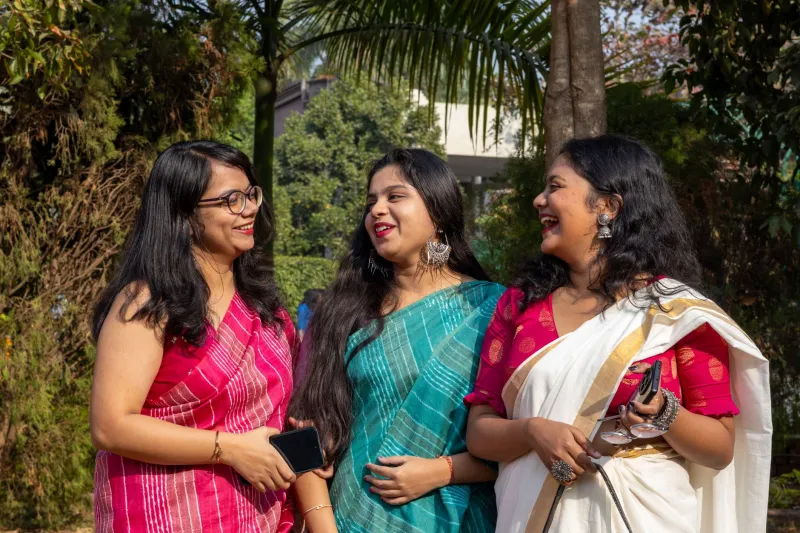
Somewhere in the American Punjabi community, there is a story that gets told over and over, with slightly different details each time. A girl grows up, excels in school, maybe becomes a doctor or a lawyer or an engineer. She is proud of her culture. She also has opinions, ambitions, and a sense of self that doesn't always fit neatly inside the shape her family imagined for her. And so she spends years — sometimes decades — navigating the space between who she's expected to be and who she actually is.
This story is real. But it's also incomplete. Because what's happening now, among second and third-generation Punjabi-American women, is something more nuanced and more interesting than a simple tension between tradition and modernity.
They're not choosing sides. They're rewriting the whole question.
The Binary That Was Never Real
The "traditional vs. Westernized" framework has always been a little bit of a trap. It assumes that Punjabi culture is a fixed, unchanging thing that you either embrace or abandon — and that American identity is some clean, secular opposite. Neither of those things is true.
"I grew up being told I was 'too American' at family gatherings and 'too Indian' everywhere else," says Simran, a 29-year-old teacher in Sacramento. "At some point I realized both of those critiques were other people's discomfort with me, not actual descriptions of who I am."
For Simran, and for many women like her, the work of the last few years has been less about finding a balance between two worlds and more about refusing the premise entirely. She celebrates Vaisakhi with the same enthusiasm she brings to a Fourth of July barbecue. She wears salwar kameez to family events and thrifted vintage to brunch. She prays in Gurmukhi and journals in English. None of this feels contradictory to her. The contradiction only appears when someone else decides it should.
Faith on Their Own Terms
For many Punjabi-American women, faith is one of the most contested and most personal arenas of this reclamation.
Sikh women, in particular, are having a visible, public conversation about their place within a religion whose founding texts preach radical gender equality — but whose institutional and community practices don't always live up to that promise. Some women are stepping into roles as granthi, as kirtan performers, as community leaders, in ways that would have been unusual or even challenged a generation ago.
"Sikhi gave me everything — the framework for my values, my sense of justice, my relationship with the Divine," says Harpreet, a 34-year-old in the Bay Area who leads a women's kirtan group. "What I pushed back against wasn't my faith. It was the cultural layer on top of it that said women should be quiet and serve and not lead."
Muslim Punjabi-American women are navigating their own version of this. Many are practicing their faith with deep intentionality while also challenging interpretations of Islam that have been filtered through patriarchal cultural norms. Hindu Punjabi-American women, too, are finding ways to engage with their spiritual heritage that honor its depth without accepting every social convention that arrived alongside it.
Across faith traditions, the through line is the same: these women are not leaving their spirituality behind. They are demanding that it actually mean what it says.
The Pressure Cooker of Perfectionism
There is a particular exhaustion that comes with being expected to excel at everything simultaneously. Punjabi-American women are often expected to be academically and professionally accomplished, culturally fluent, physically presentable, emotionally available, and eventually — on someone else's timeline — married and maternal.
The weight of that expectation doesn't disappear when you become an adult. It just changes shape.
"My mom worked two jobs and raised three kids and never complained," says Divya, a 38-year-old marketing director in Chicago. "I love her so much for that. But I also watched her disappear into that role. I don't want to disappear."
Divya spent most of her twenties trying to meet every expectation simultaneously — the career, the dutiful daughter role, the perfect partner search — before burning out spectacularly at 32. What followed was a long, uncomfortable process of figuring out what she actually wanted versus what she'd been trained to want.
"I still want a lot of the same things," she says. "Family, community, a life with meaning. But I want them because I chose them. Not because I was afraid of what happens if I don't."
Motherhood, Reimagined
For Punjabi-American women who are raising children, the negotiation takes on another dimension. They are making real-time decisions about what to pass on and what to put down.
Many are raising their kids bilingual, making sure Punjabi doesn't disappear in the third generation. They're taking their children to the gurdwara or mandir while also having honest conversations about what faith means and why it matters. They're cooking daal and saag and telling their kids the stories behind the food — but they're also refusing to let cooking be the only story they pass down.
"I want my daughter to know how to make paratha and how to negotiate a salary," says Aman, a 41-year-old mother of two in Houston. "I want her to know the Mool Mantar and also know that she has the right to say no. Those things aren't in conflict."
The Community They're Building
What's perhaps most striking about this generation of Punjabi-American women is that they are not doing this work alone. They're building community with each other — through group chats and local meetups, through online spaces and grassroots organizations, through the simple act of saying out loud the things that used to only be whispered.
They are finding each other, recognizing each other, and creating the kind of space they needed when they were younger and couldn't find it.
The boxes are still there — the family expectations, the community pressures, the cultural assumptions that arrive wrapped in love. But more and more, these women are looking at those boxes and choosing, deliberately, to step outside them.
Not away from their culture. Deeper into a version of it that actually has room for them.