Where the Ardas Holds Everyone: Queer Punjabi-Americans Are Not Leaving Their Spirituality Behind
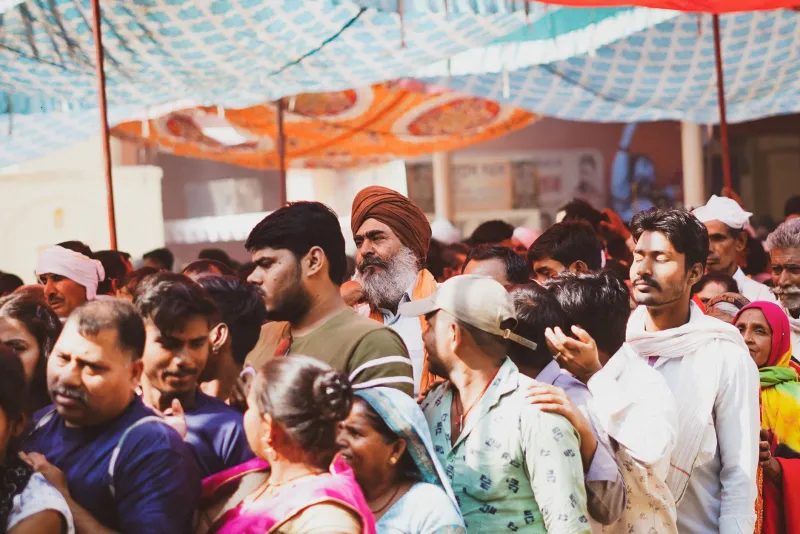
The word sangat means congregation, but it carries more than its dictionary definition. In Sikh practice, sangat is the community that gathers — not just physically, but spiritually. It's the idea that the presence of others in worship has its own power, that you are not meant to navigate the sacred alone. For queer and trans Punjabi-Americans, that concept has become both a source of pain and, increasingly, a site of reclamation.
The pain is familiar to many. The experience of loving a tradition — its music, its food, its stories, the specific quality of light in a gurdwara on a Sunday morning — while feeling unseen or actively unwelcome within its institutional spaces is a particular kind of grief. It's not clean. It doesn't resolve neatly. And it doesn't necessarily produce a desire to walk away from the tradition itself.
What it increasingly produces, in Punjabi-American communities across the US, is the impulse to build something new inside the old — or alongside it.
The Gurdwara Question
It would be inaccurate to characterize all Sikh institutions in America as uniformly unwelcoming to LGBTQ+ community members. The reality is considerably more varied and, in some places, actively evolving. Some gurdwaras, particularly those with younger congregational leadership or in more progressive metropolitan areas, have made explicit efforts to create inclusive environments. Others remain more traditional in their approach to questions of gender and sexuality.
For many queer Punjabi-Americans, the question isn't simply whether they are formally welcomed or excluded. It's subtler than that. It's about whether they can bring their whole selves into a space — whether the version of themselves that walks through the langar hall is the same one that exists everywhere else. That gap between formal tolerance and genuine belonging is where a lot of the most important cultural work is currently happening.
Some community members have chosen to remain within their home gurdwaras while quietly building networks of support and solidarity that exist alongside the official institutional structure. Others have sought out or helped create explicitly inclusive congregational spaces. Still others have stepped back from institutional religion altogether while maintaining deep personal spiritual practices rooted in Sikhi or Punjabi folk traditions.
All of these are real responses to a real tension, and all of them deserve to be seen as legitimate rather than ranked on a scale of authenticity.
Art as Ardas
One of the most striking developments in queer Punjabi-American community life is the role that artistic practice has taken on as a form of spiritual expression — sometimes explicitly, sometimes organically.
Performance artists, poets, visual artists, and musicians in this community are creating work that draws directly on Sikh scripture, Punjabi folk traditions, and the aesthetic vocabulary of their heritage while centering queer and trans experiences. This isn't subversion for its own sake. For many of these artists, the work feels more like restoration — an argument, made in beauty, that these traditions were always capacious enough to hold them.
Poetry rooted in the Gurbani's themes of love, longing, and the dissolution of ego finds new resonance when read through a queer lens. Bhangra and Giddha — folk dance forms that carry specific gender associations in their traditional forms — are being reinterpreted by queer dancers in ways that honor the movement's roots while expanding who gets to inhabit them. Visual artists are creating work that places queer and trans Punjabi figures inside devotional imagery, not as provocation but as presence.
The response to this work within the community is not uniform, but it is significant. For younger Punjabi-Americans — queer and straight — encountering this art often produces a kind of recognition: the sense that their culture is bigger and more flexible than they were led to believe.
Building New Sangats
Across cities like New York, Los Angeles, Chicago, and the Bay Area, queer Punjabi-Americans have been building community structures that function as sangats in the deepest sense of the word — spaces of collective spiritual and emotional sustenance.
Some of these take the form of regular gatherings that incorporate elements of Sikh practice: kirtan, langar, ardas. Others are more loosely structured — dinner groups, reading circles, collective art projects — that function as community without the formal trappings of religious practice. What they share is an insistence on integration: the refusal to compartmentalize queerness and Punjabi-ness into separate boxes that never touch.
The role of food in these spaces is worth noting specifically. Langar — the free community kitchen that is one of Sikhi's most radical and beloved institutions — carries enormous symbolic weight for Punjabi people regardless of their relationship to formal religion. The act of cooking together, sharing a meal, serving others without hierarchy: these are gestures that connect deeply to heritage. In queer Punjabi spaces, the kitchen has become a kind of altar. Cooking your grandmother's dal while your community gathers around you is a spiritual act, whether or not anyone names it that way.
The Family Conversation That Never Ends
No honest account of queer Punjabi-American life can avoid the complexity of family. For many people in this community, family is simultaneously the source of the deepest belonging and the site of the most painful rejection. And crucially, those two things often coexist in the same family, sometimes in the same person.
The narrative of total rejection — queer child cut off from family, forced to choose between identity and heritage — is real and must be acknowledged. But it's not the only story. Many queer Punjabi-Americans describe relationships with family that are complicated, evolving, sometimes painful and sometimes unexpectedly tender. Parents who don't fully understand but don't walk away. Grandparents whose love turns out to be less conditional than expected. Siblings who become unexpected allies.
The work of navigating these relationships — holding your own truth while remaining in relationship with people who are still working through theirs — is its own form of spiritual practice. It requires patience, self-knowledge, and a willingness to let people be imperfect without giving up on them entirely.
Artists and community leaders in this space often talk about this navigation as something that has deepened rather than diminished their connection to their culture. The Punjabi traditions they were raised in — the emphasis on community, on service, on the irreducible dignity of every person — turn out to contain the seeds of the inclusion they're working toward. They're not importing foreign values into their heritage. They're holding their heritage accountable to itself.
A Presence, Not a Petition
What's most striking about queer Punjabi-American community-building right now is its tone. This is not primarily a movement of protest or demand, though it contains those energies. It's more fundamentally a movement of presence — an insistence on existing fully, visibly, and joyfully within a culture and a spiritual tradition that some have tried to tell them they don't belong in.
The ardas is a prayer that asks for the welfare of all. Sarbat da bhala — the well-being of everyone. Queer Punjabi-Americans aren't asking to be included in that prayer. They're reminding everyone that they always already were.