Something Borrowed, Something Reclaimed: How Young Punjabi-Americans Are Rewriting the Wedding Playbook
There's a particular kind of pressure that shows up about six months before a Punjabi wedding. It arrives in the form of a WhatsApp message from a relative you haven't spoken to since the last wedding, a spreadsheet your mom has been quietly building since your sophomore year of college, and a vendor quote that makes your stomach drop.
For Simran Dhaliwal, a 29-year-old graphic designer based in Fremont, California, that pressure hit differently. "I love my culture. I love the rituals, the music, the food — all of it," she told me. "But somewhere between the third venue walkthrough and the fourth time someone told me what I had to include, I realized I was planning a wedding for everyone except me and my partner."
She's not alone. Across the US, second-generation Punjabi-Americans are pushing back against what some are calling the wedding industrial complex — that sprawling, expensive, often exhausting machinery of vendors, expectations, and inherited traditions that can turn one of the most personal days of your life into a performance for the community.
And they're doing it with a lot of love, a little DIY, and a willingness to have some genuinely uncomfortable conversations.
The Economics of Tradition
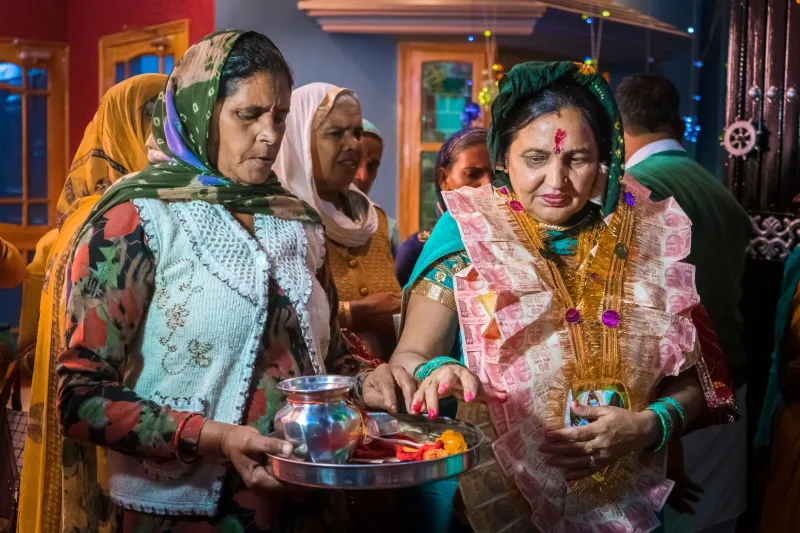
Let's talk about mehndi. For Punjabi weddings, it's not optional — it's sacred, it's beautiful, and it's deeply tied to the emotional arc of a bride's pre-wedding rituals. It's also, depending on where you live in the US, wildly expensive.
In cities like Chicago, Houston, and the Bay Area, professional mehndi artists for a full bridal session can run anywhere from $300 to over $1,000. Add in the mehndi ceremony itself — the space rental, the outfits, the catering — and you're looking at a significant chunk of a wedding budget before you've even touched the main event.
"I started asking questions about where all this money was actually going," said Priya Bains, a 32-year-old attorney in Atlanta who got married last spring. "Not because I didn't want to celebrate, but because I wanted to celebrate intentionally. Some of these vendor packages felt less like culture and more like capitalism wearing a lehenga."
Priya and her husband Arjun ended up hosting a mehndi evening in her parents' backyard, hiring a local artist they found through Instagram, and asking aunties and cousins to contribute dishes instead of gifts. "It was loud and chaotic and honestly the best night of the whole wedding weekend," she said. "It felt like us."
DIY as a Political Act
There's something quietly radical about a Punjabi-American couple deciding to hand-stamp their own invitations or build their own floral backdrop out of marigolds ordered wholesale from a flower market. It's not just budget-consciousness — for many, it's a reclamation.
When so much of South Asian wedding culture in the US gets filtered through a lens of competitive spending and community optics, choosing to do things yourself becomes a statement. It says: we're not here to impress anyone. We're here to mark something real.
Raj and Kavleen Sandhu, a couple from the Seattle area, went full DIY for their Anand Karaj ceremony last year. Kavleen, who has a background in textile arts, hand-embroidered details on their wedding garments. Raj built the wooden display stands for their photo table. They sourced their phulkari decor from a small artisan collective rather than a wedding rental company.
"People kept asking us if we were doing it to save money," Raj laughed. "And sure, that was part of it. But mostly we wanted every element to have a story we could actually tell. I made that. She stitched this. That matters to us."
When Two Traditions Meet the Mandap
For interfaith and intercultural Punjabi couples, the reimagining goes even deeper. How do you honor a Sikh ceremony when your partner is Hindu, or Catholic, or has no religious background at all? How do you create a ritual space that holds both of you — fully?
This is territory that officiants, families, and couples are navigating in real time, without a lot of established roadmaps.
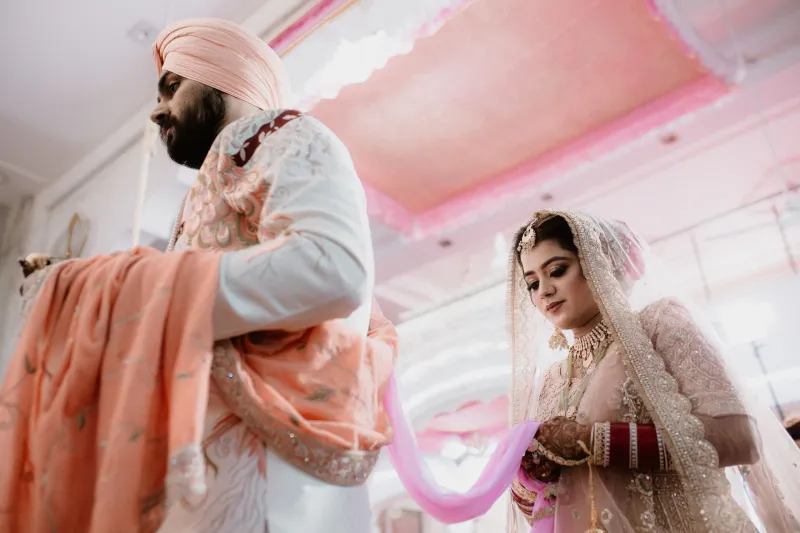
Amrita Grewal, who married her partner Daniel — a Mexican-American from San Antonio — two years ago, describes their wedding as "a beautiful negotiation." They incorporated the Anand Karaj at a local Gurdwara, followed by a civil ceremony that wove in elements from both families. There were marigolds and papel picado. There was a dhol player and a mariachi band. There was, apparently, a moment where both grandmothers ended up dancing together that nobody planned but everyone remembers.
"We got some side-eye from people on both sides," Amrita admitted. "But honestly, the elders who mattered most to us were just happy we were happy. It was the people our age who had the most opinions, which was kind of ironic."
The Family Conversation Nobody Wants to Have
Here's the part that doesn't get talked about enough: the actual conversations couples have to have with their families when they decide to break from tradition.
These aren't easy. They're layered with love, guilt, generational sacrifice, and genuine grief — because for many Punjabi parents, their child's wedding is also their moment. It's the culmination of decades of immigration, hard work, and holding culture together in a country that didn't always make that easy.
"My mom cried when I told her we were cutting the baraat," Simran told me. "Not because she was angry. Because she had been imagining that moment for years. And I had to sit with that. I had to really hear it."
What Simran and her partner did next is something more and more couples are trying: they had a series of conversations — not a single ultimatum — where they explained their reasoning, listened to their families' feelings, and found places to compromise. They kept the doli. They added a moment in the ceremony where both sets of parents were formally acknowledged. They let her mom pick the floral color scheme.
"It wasn't perfect," Simran said. "But it was honest. And that felt more like us than any Pinterest board ever could."
Authenticity Isn't a Trend
What strikes me most about these couples isn't that they're rejecting Punjabi wedding culture. They're not. They're interrogating it — asking which parts carry genuine meaning and which parts are just inherited performance.
That's actually a very Punjabi thing to do. A culture that has survived partition, migration, and diaspora didn't get here by staying rigid. It got here by holding onto what matters and adapting everything else.
The marigolds still show up. The gurbani still fills the hall. The aunties still cry at the doli. But now, sometimes, the couple helped string the flowers themselves. The ceremony includes a moment that belongs to no tradition except their own. And the whole thing feels — maybe for the first time — like it was actually made for them.
That's not decolonization as a buzzword. That's just two people deciding what their life together is going to look like, and having the courage to say it out loud.
And if you ask me, that's worth celebrating.