Tied to Something Bigger: How Punjabi-American Men Are Rewriting the Story of the Dastar
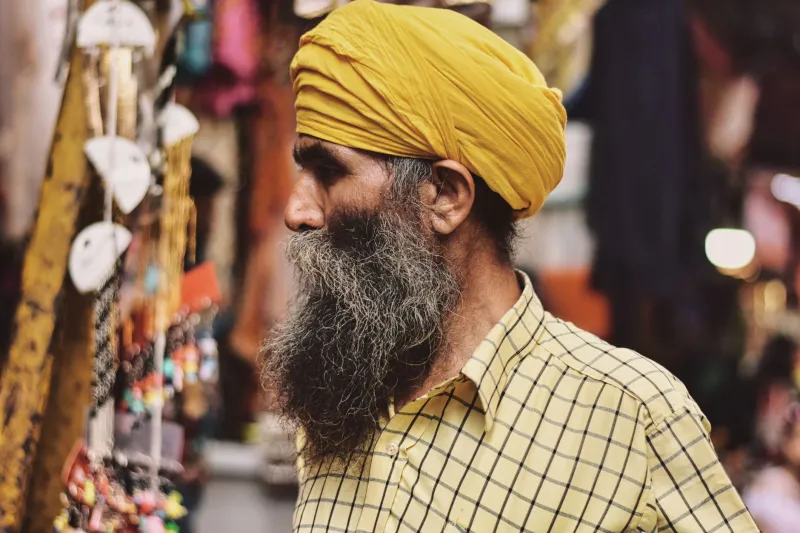
There's a moment that a lot of Punjabi-American men can describe with uncomfortable precision. It's the pause — that half-second when a stranger's eyes land on their turban and something shifts. Maybe it's a step back. Maybe it's a stare that goes a beat too long. Maybe it's a TSA agent's hand raised before anyone else in the line gets stopped.
That moment has a history. And it didn't start in 2001 — but September 11 certainly made it louder.
While Punjabi women's head coverings have slowly found their way into fashion editorials and mainstream conversations about South Asian style, the men's dastar has occupied a different kind of American imagination. It's been flattened, misread, and in some cases, treated as a threat. For a generation of Punjabi-American men who grew up in the aftermath of 9/11, the choice to wear or not wear a turban became one of the most loaded decisions of their lives.
But something is shifting. Slowly, loudly, and on their own terms.
The Weight of a Misread Symbol
The Sikh turban — the dastar — is one of the most recognizable articles of faith in the world. For practicing Sikhs, it's not optional. It's a commitment, a crown, a daily act of devotion. But in post-9/11 America, it became something else in the public eye: a shorthand for "foreign" and, in the darkest corners of that moment, something far more dangerous.
Balbir Singh Sodhi, a Sikh gas station owner in Mesa, Arizona, was murdered just four days after the Twin Towers fell. He was the first person killed in a hate crime directly linked to 9/11 backlash. He was wearing a turban. He was Punjabi. He was not Muslim. But in that moment of national grief turned to rage, none of that mattered.
That murder sent a shockwave through Punjabi-Sikh communities across the US that still reverberates today. Parents quietly encouraged sons to reconsider the dastar. Some families who had worn turbans for generations made painful, pragmatic choices. Survival, they reasoned, looked like invisibility.
A Generation Caught Between Two Pulls
For many Punjabi-American men who came of age in the 2000s and 2010s, the turban question wasn't just spiritual — it was social. Would it affect their college applications? Their job interviews? Their dating lives? Their safety walking home?
Those questions didn't come from nowhere. Workplace discrimination cases involving turbaned Sikhs have been documented across industries, from the US military to retail. The EEOC has handled hundreds of religious accommodation complaints from Sikh employees over the past two decades. The legal wins are real, but the daily friction is realer.
And yet, something unexpected happened alongside all of that: resistance became a creative act.
Performers, artists, and athletes started showing up — turbaned and unapologetic. Musician Harpreet Singh, who performs across the East Coast's South Asian festival circuit, has talked openly about the decision to perform in his dastar after years of internal debate. "The stage became the place I stopped apologizing," he's said in interviews. "When the music is Punjabi and I look Punjabi, something completes."
From Invisibility to Statement
Social media has played an enormous role in this shift. Punjabi-American creators on TikTok and Instagram have been quietly building a new visual vocabulary around the dastar — styling videos, historical explainers, casual day-in-the-life content that shows turbaned men grocery shopping, working out, going on dates, coding at startups, doing stand-up comedy.
It sounds simple. It isn't.
What these creators are doing is inserting normalcy where fear and otherness once lived. They're not explaining themselves to a non-Sikh audience or asking for tolerance. They're just existing, loudly, in a medium that rewards authenticity. And the audiences following them are mixed — South Asian diaspora kids hungry for representation, curious non-Punjabi Americans, and everyone in between.
Activists and educators have been working the longer game. Organizations like the Sikh Coalition have spent years fighting for policy changes — successfully advocating for turbaned Sikhs to serve in the US military, pushing back on TSA screening protocols, and building legal frameworks that protect religious expression in public life. These aren't abstract victories. They're the kind of institutional change that makes everyday visibility less dangerous.
The Dastar in the Boardroom
Here's a version of the story that doesn't get told enough: the Punjabi-American professional who ties his dastar every morning and walks into a meeting room where he is the only turbaned person in the building. Every. Single. Day.
This is the quiet front line. No protest signs, no viral videos. Just the daily negotiation of being visibly different in a space that wasn't designed with you in mind.
Some men describe it as exhausting. Others describe it as clarifying. "It filters people fast," one tech professional based in the Bay Area put it. "If someone can't get past what's on my head, I know pretty quickly we're not going to work well together."
What's notable is how many younger Punjabi-American men are choosing the dastar not despite these challenges, but almost because of them. There's a generation that watched their parents and older siblings navigate America with their identity partially tucked away, and decided that's not the trade they want to make.
What the Dastar Carries
For Shreya Punjab, this story lives at the intersection of everything we care about — art, identity, the way culture travels and transforms across borders and generations. The dastar isn't just a religious article. It's a canvas. It's a statement. It's a conversation starter and sometimes a confrontation.
Punjabi textile traditions are ancient and meticulous, and the art of tying a dastar is itself a practice passed between generations — father to son, uncle to nephew, community elder to young man. The colors carry meaning. The style of the tie reflects regional identity and personal expression. It is, in every sense, wearable culture.
When a Punjabi-American man ties his dastar in a bathroom mirror in Chicago or Houston or New Jersey, he's doing something that connects him to a lineage stretching back centuries. He's also doing something entirely new — navigating a country that is still learning, slowly and imperfectly, what it means to make room for all of that.
Still Becoming
The story of the dastar in America isn't finished. It's still being written in courtrooms and classrooms, on stages and social feeds, in family kitchens where the conversation gets complicated and honest.
What feels different now is the tone. Less apologetic. More grounded. A generation that has absorbed the fear of the post-9/11 years and decided, collectively, that they'd rather be seen clearly than not seen at all.
That's not a small thing. That's the whole thing.